Dubai Mainland vs Free Zone: The Ultimate 2026 Comparison Guide
Business Setup
Sep 8, 2026
13 Min Read

Your 2026 guide to the dubai mainland vs free zone decision. Compare tax rules, trading scope, visas and banking to choose the right jurisdiction with confidence.
In 2026, choosing a jurisdiction based solely on 100% foreign ownership is a legacy mistake that could cost your business millions in missed opportunities. While the dubai mainland vs free zone debate used to center on who owned the company shares, the modern landscape is now defined by “qualifying income,” physical market access, and the strategic navigation of the 9% corporate tax threshold.
It’s natural to feel concerned about the evolving regulatory environment. Between the fear of tax liabilities on income exceeding AED 375,000 and the notorious hurdles of opening a corporate bank account, the administrative weight can feel like a barrier to your commercial growth. You need a structure that scales without the friction of complex visa requirements or PRO delays.
This guide will help you master the critical differences between mainland and free zone jurisdictions so you can choose the most profitable path for your UAE venture. We’ll break down the nuances of tax liability, explain how to leverage Small Business Relief for revenues up to AED 3 million, and provide a clear roadmap for seamless banking and visa integration. You’ll gain the clarity needed to make a definitive decision on where your business belongs.
Key Takeaways
Evaluate the fundamental shift in the dubai mainland vs free zone debate, focusing on how your choice impacts “Qualifying Income” and access to the local UAE market.
Navigate the 9% corporate tax landscape with confidence by understanding the specific thresholds and Small Business Relief eligibility for revenues up to AED 3 million.
Determine the ideal jurisdiction for your sector, whether you require the last-mile logistics of a mainland license or the specialized infrastructure of free zones like Meydan or Ajman.
Master the logistics of scaling your team by aligning your physical office footprint with visa quotas and streamlined PRO requirements.
Identify the strategic advantages of integrated support, from securing corporate bank account approvals to implementing Zoho CRM for long-term operational efficiency.
Table of Contents
The 2026 UAE Business Landscape: Mainland vs Free Zone Defined
Key Structural Differences: Ownership, Tax, and Trading Scope
Activity-Based Selection: Which Jurisdiction Fits Your Industry?
Practical Logistics: Visas, Banking, and PRO Services
Strategic Setup with Unispire: Building a Compliant Future
The 2026 UAE Business Landscape: Mainland vs Free Zone Defined
The UAE business environment has reached a phase of sophisticated regulatory maturity. In 2026, the historical barriers that once forced entrepreneurs into specific corners of the market have largely dissolved. The most significant shift is the full integration of 100% foreign ownership for mainland companies, a change that applies to more than 1,000 commercial and industrial activities. This means the old requirement for a local Emirati partner to hold a 51% share is a thing of the past for the vast majority of sectors. Today, the dubai mainland vs free zone decision is driven by your operational goals, tax optimization strategy, and your need for physical market access.
2026 stands as a landmark year because the legal framework for Corporate Tax is now fully operational. Every entity, whether onshore or within a specialized zone, must align with the Federal Decree-Law No. 47 of 2022. This clarity allows founders to build long-term structures with a level of certainty that didn’t exist five years ago. You aren’t just choosing a license; you’re choosing a jurisdiction that dictates your relationship with the Federal Tax Authority (FTA) and your ability to scale across the seven emirates.
Understanding the Mainland (Onshore) Concept
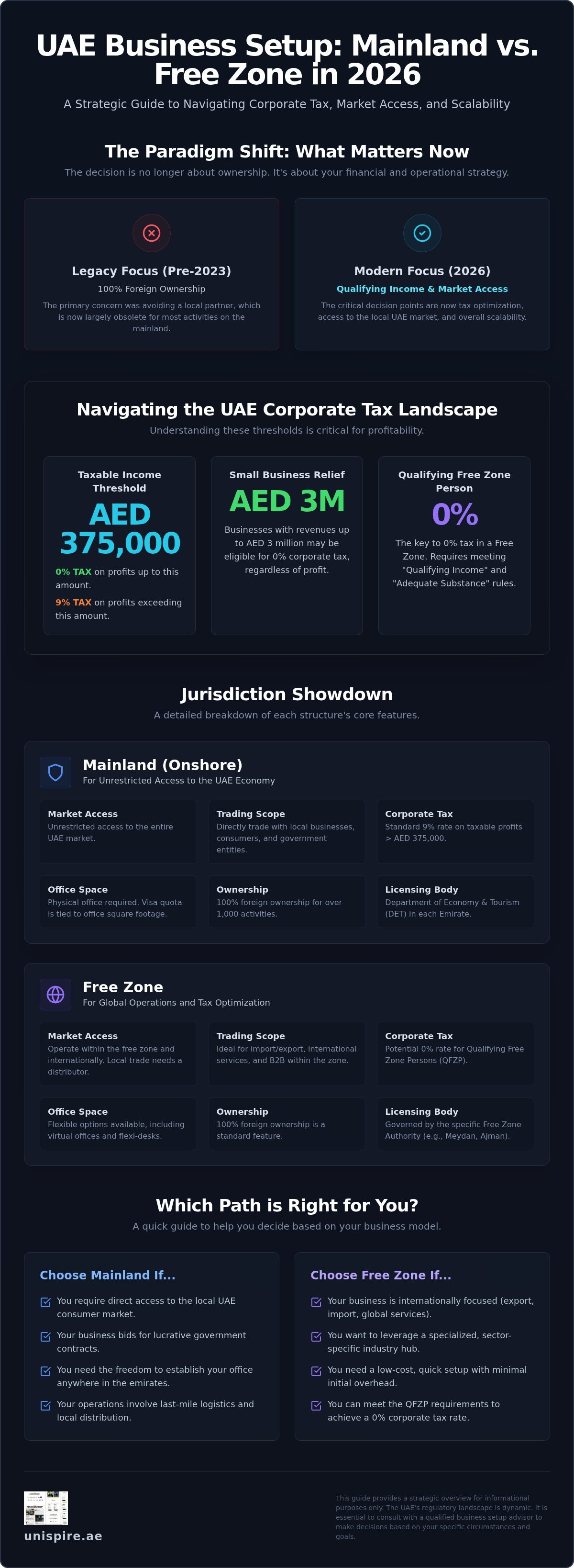
Mainland companies are onshore entities licensed directly by the Department of Economy and Tourism (DET). The primary advantage of this structure is unrestricted access to the entire UAE market. If your business model relies on bidding for lucrative government contracts or trading directly with local consumers without an intermediary, the mainland is your logical destination. There are no geographic restrictions on where you can lease office space, allowing you to position your headquarters in the heart of Dubai’s commercial hubs.
It’s vital to remember that mainland licenses are tied to physical infrastructure. Your visa quota is determined by the square footage of your office space. This requirement ensures that mainland businesses maintain a tangible footprint in the local economy, which often simplifies the process when you’re ready to scale your team or apply for specialized permits.
The Evolution of UAE Free Zones
Free zones have evolved into highly specialized economic ecosystems. Rather than being generic “tax-free” enclaves, modern zones like Meydan or Ajman are designed as sector-specific hubs. You can find a comprehensive List of UAE Free Zones that highlights how these jurisdictions cater to everything from commodities trading to creative digital agencies. They offer a streamlined entry point for startups, featuring flexi-desk options and virtual office solutions that keep initial overheads low.
In the 2026 landscape, the distinction of “Designated Zones” remains critical for VAT and customs purposes. While free zone companies are generally restricted to trading within their zone or internationally, they provide a protected environment for “Qualifying Free Zone Persons” to optimize their tax position. Choosing a free zone is a strategic move for businesses that are globally focused and require a plug-and-play administrative framework to launch quickly.
Key Structural Differences: Ownership, Tax, and Trading Scope
Understanding the dubai mainland vs free zone framework requires a deep look at your financial bottom line and long-term scaling strategy. In 2026, it’s no longer just about where your office is located; it’s about how your revenue is classified and how your goods move through the borders. While both jurisdictions offer 100% ownership for most activities, the structural nuances in tax and trade can significantly impact your net profit. For professional licenses on the mainland, such as consultancy or legal services, you may still interact with a Local Service Agent (LSA). This individual doesn’t hold equity but acts as your administrative liaison with government bodies, a role that differs from the hands-off approach of free zone authorities.
Taxation in 2026: The QFZP Framework
The introduction of UAE Corporate Tax has changed the game for everyone. To benefit from a 0% tax rate in a free zone, your entity must meet the criteria of a Qualifying Free Zone Person (QFZP). This status isn’t automatic; it requires maintaining “adequate substance” and ensuring your revenue qualifies under specific government definitions. If your income doesn’t qualify, or if you operate on the mainland, you’ll be subject to a 9% tax on taxable profits exceeding AED 375,000.
Small businesses have a significant advantage through the Small Business Relief program. If your revenue stays at or below AED 3 million for the tax period, you can elect to be treated as having no taxable income. This relief is available until the end of 2026, providing a vital cushion for startups. Don’t forget that VAT registration remains a separate, mandatory requirement once your taxable supplies and imports exceed AED 375,000, regardless of your jurisdiction. Ensuring your VAT registration and filing is handled accurately from day one is the best way to avoid heavy penalties.
Trading Restrictions and Market Access
Mainland companies hold the “golden ticket” for local market access. They can bid for lucrative government tenders and trade directly with any business or consumer across all seven emirates. Free zone companies are technically restricted to trading within their designated zone or internationally. To access the local UAE market, a free zone entity typically must work through a mainland distributor or establish a mainland branch, which adds a layer of complexity and cost.
Logistics and re-export businesses often prefer free zones because they are considered “outside” the UAE customs territory. This allows you to move goods in and out without paying customs duties, provided the goods don’t enter the mainland. As the Abu Dhabi DED highlights, the choice between these two depends heavily on whether your primary client base is local or global. If your goal is to become a key supplier for UAE government projects, the mainland is your only viable path.
Activity-Based Selection: Which Jurisdiction Fits Your Industry?
Your business activity is the primary driver in the dubai mainland vs free zone decision. While the legalities of ownership have converged, the operational realities of different sectors remain distinct. For example, e-commerce businesses focused on the local UAE market often find that a mainland license is indispensable for last-mile delivery and direct consumer interaction. If your business model involves physical products moving within the Emirates, being onshore simplifies your logistics chain and allows you to lease warehouse space anywhere in the country.
Trading and manufacturing entities must weigh the benefits of customs exemptions against the need for local market penetration. If your goal is re-exporting goods globally, a free zone warehouse offers a duty-free environment that maximizes margins. Conversely, if you’re a holding company managing a diverse international portfolio, the choice becomes more about the specific regulatory framework and the ease of asset protection offered by different jurisdictions. Each structure serves a specific strategic purpose.
Service-Based Businesses and the Mainland Advantage
Professional service providers, including law firms, creative agencies, and management consultants, often choose Mainland Company Formation to build a tangible presence within the community. A mainland professional license allows for 100% foreign ownership while granting you the flexibility to open multiple branch offices across different Emirates. This is a significant advantage for firms that need to be close to their corporate clients or government departments. The setup process is efficient, often requiring a trade name registration fee of approximately AED 620 to get started.
Tech and Digital Nomads: The Free Zone Appeal
For remote entrepreneurs and tech startups, a Free Zone Company Formation offers a plug-and-play ecosystem. Locations like Meydan and Ajman have become the preferred choice for digital nomads due to their cost-effective structures. A Meydan freezone business setup is particularly attractive, with license packages starting as low as AED 12,500. These zones provide robust Intellectual Property (IP) protection and foster a networking environment where tech founders can collaborate. If your business is location-independent and focuses on digital services, an Ajman freezone business setup provides the speed and flexibility you need to launch without the overhead of a large physical office.
Practical Logistics: Visas, Banking, and PRO Services
Logistics are the ultimate filter in the dubai mainland vs free zone decision. While the license gets you through the door, your ability to hire talent and move capital depends on administrative precision. On the mainland, your visa quota is strictly tied to the square footage of your physical office. You’ll typically need to lease enough space to justify your headcount, ensuring a tangible economic footprint in the local market. Free zones, by contrast, offer “visa packages” that allow startups to scale without immediately committing to large physical premises, often providing flexi-desk options that include one or two visa allocations.
Government documentation and annual renewals require constant oversight to avoid fines. Dedicated PRO Services act as your bridge to the authorities, managing everything from labor contracts to trade name renewals with speed and accuracy. You also need to remain vigilant regarding Economic Substance Regulations (ESR). Although there is some industry discussion about its future, the UAE Ministry of Economy currently maintains requirements for companies engaged in “relevant activities.” Ignoring these filings can lead to significant administrative penalties, making expert oversight a necessity for 2026 compliance.
Residency and the UAE Golden Visa
In 2026, savvy investors are looking beyond standard residency. By aligning your business setup with a 10-year Golden Visa, you secure long-term stability for your family and key talent. This visa removes the need for a local sponsor and allows for 100% ownership of your residency status, regardless of your corporate structure. Unispire Group LLC Fz streamlines this process, ensuring your application meets all investment and professional criteria from the start. We handle the “admin” so you can focus on scaling your operations within the UAE’s high-energy business environment.
The Corporate Banking Hurdle
Opening a corporate bank account remains one of the most challenging steps in the setup journey. Banks prioritize “substance” during their Know Your Customer (KYC) checks, especially following the full implementation of corporate tax. Mainland companies often have a smoother path because a physical office and local trade provide immediate proof of operations. Free zone entities, particularly those using virtual offices, may face stricter scrutiny. To succeed in your first 30 days, you must present a clear business plan, verified source of wealth, and proof of regional trade. If you want to bypass the stress of rejected applications, leverage our Corporate Bank Account Opening Assistance to prepare a bank-ready profile that meets the specific requirements of UAE financial institutions.
Strategic Setup with Unispire: Building a Compliant Future
Securing a license is only the entry point into the UAE’s competitive market. In 2026, the real challenge lies in building an operation that remains compliant and scalable. Whether your final assessment leads you toward a dubai mainland vs free zone structure, your focus must shift toward administrative efficiency. Unispire Group LLC Fz functions as your strategic ally, replacing the stress of government filings with a streamlined, end-to-end approach. We manage the intricacies of PRO services and VAT registration, allowing your founding team to focus entirely on commercial growth and market penetration.
Choosing the right jurisdiction requires a personalized evaluation of your long-term goals. The dubai mainland vs free zone decision often hinges on whether you need a prestigious address with modern digital infrastructure, like a Meydan freezone business setup, or an exceptionally cost-effective entry point like an Ajman freezone business setup. For those requiring direct access to government tenders, a mainland company formation remains the gold standard. We analyze these variables against your specific industry to ensure your chosen structure minimizes tax liability while maximizing operational flexibility.
Automating Your Growth with Zoho CRM
Many entrepreneurs overlook the synergy between their corporate structure and their technology stack during the early stages of formation. We bridge this gap through expert Zoho CRM implementation. By automating your workflows from day one, you ensure that licensing data, customer interactions, and financial records are perfectly synchronized. This digital foundation is what separates a standard startup from a high-growth enterprise in the modern UAE economy. Our in-house technical team works alongside our legal consultants to build a system that supports your sales funnel while maintaining the record-keeping standards required by the Federal Tax Authority.
Next Steps: Your UAE Business Roadmap
The transition from planning to execution happens swiftly when you follow a methodical, structured path. We begin with your initial approval and trade name reservation, moving quickly to license issuance. Once your legal entity is active, we prioritize corporate bank account opening assistance to secure your financial integration. This is also the ideal time to evaluate your residency options. Our Golden Visa processing service can help you secure long-term stability for your family and key executives, removing the traditional hurdles of annual renewals.
Success in 2026 also requires a proactive stance on fiscal responsibility. You’ll need to maintain rigorous compliance, ensuring your filings meet the AED 375,000 corporate tax threshold requirements or electing for Small Business Relief if your revenue stays below AED 3 million. We act as your vital bridge to these intricate requirements, ensuring you never miss a deadline or a regulatory update. Book your strategic consultation with Unispire Group LLC Fz today to finalize your jurisdiction choice and begin your setup with professional rigor and expert oversight.
Secure Your Strategic Advantage in the UAE Market
The choice between a dubai mainland vs free zone structure is the most consequential decision you’ll make for your enterprise in 2026. Success in this evolving landscape requires more than just a trade license; it demands a sophisticated alignment of your tax strategy, physical footprint, and operational technology. Whether you need the unrestricted market access of the mainland or the specialized ecosystems of Meydan and Ajman, your setup must be built for long-term compliance and scalability.
Unispire Group LLC Fz stands as your dedicated navigator through this complex administrative landscape. We specialize in Meydan and Ajman free zone setups while providing expert Golden Visa and PRO support to secure your residency and government relations. Our unique position as Zoho CRM implementation partners ensures that your business doesn’t just exist on paper but thrives through automated, modern workflows. We handle the technical and legal weight so you can focus on your commercial vision.
Start your UAE business journey with Unispire’s expert guidance and transform the potential stress of setup into a streamlined path toward growth. The high-energy economy of Dubai is waiting for your innovation. Let’s build a foundation that turns your ambition into a profitable reality.
Frequently Asked Questions
Can a free zone company do business in mainland Dubai in 2026?
A free zone company can only do business in mainland Dubai through a mainland branch or a licensed local distributor. You can’t trade directly with mainland customers or bid for local government contracts without this intermediary. This restriction is a central factor when weighing the dubai mainland vs free zone options for your specific business model.
Is a Dubai free zone company still tax-free after the 2026 corporate tax changes?
Free zone companies are not automatically tax-free in 2026. A 0% rate applies only to qualifying income for Qualifying Free Zone Persons. Any income that doesn’t meet these criteria is taxed at the standard 9% rate for profits exceeding AED 375,000. However, businesses with revenue under AED 3 million may still benefit from Small Business Relief until the end of the 2026 tax year.
Do I still need a UAE national sponsor for a mainland company?
You don’t need a UAE national sponsor for the majority of mainland activities. The law now allows 100% foreign ownership for over 1,000 commercial and industrial sectors. For professional licenses, you’ll still appoint a Local Service Agent, but they hold 0% equity in your company. This ensures you maintain full control over your commercial growth and decision-making.
Which is cheaper to set up: free zone or mainland?
In the dubai mainland vs free zone comparison, free zones are typically the more cost-effective entry point for startups. For instance, a Meydan Free Zone license starts at AED 12,500. Mainland setup involves higher initial costs because you must lease a physical office and pay DET registration fees. These mainland costs often start between AED 12,000 and AED 25,000 depending on your activity.
Can I switch from a free zone to a mainland license later?
You cannot directly convert a free zone license into a mainland one. If you want to move your operations onshore, you’ll need to establish a new mainland entity or open a branch of your free zone company. This requires a fresh application through the Department of Economy and Tourism and the cancellation or restructuring of your existing license.
What are the office requirements for a mainland company vs a free zone?
Mainland companies must have a physical office with a verified Ejari to secure visa quotas. Free zones offer more flexibility, providing virtual offices or flexi-desk solutions for lean teams. However, be aware that a physical office often improves your chances of a successful corporate bank account opening. Banks prioritize entities with a tangible footprint in the UAE.
How long does it take to open a corporate bank account in the UAE?
Opening a corporate bank account in the UAE usually takes between 4 and 12 weeks. The timeline depends on the complexity of your ownership structure and the quality of your documentation. Traditional banks have rigorous KYC checks, so having a clear business plan and proof of trade is essential. Digital banks offer a faster alternative for simpler business structures.
Can I apply for a Golden Visa through a free zone company?
Yes, you can apply for a 10-year Golden Visa while operating through a free zone entity. You’ll need to meet specific investment or professional criteria, such as property ownership or holding a senior executive role. This long-term residency provides stability for your family and key talent. Our team manages the integration of your business setup with the Golden Visa application.
Author
Asmar Bashir
Asmar Bashir is the face of the Unispire industry and has a background in corporate real estate and business Consultation & Management Zone.
Join our newsletter list
Sign up to get the most recent blog articles in your email every week.
Similar Blogs